Elite Energy News
Pros and Cons of Solar Panels in the UK
For most UK homeowners, the pros and cons of solar panels point firmly in one direction – they're a strong investment. A typical system cuts electricity bills by £400–£600 per year, pays back within 6–10 years, and continues generating free electricity for 15–20 years beyond that.
That said, every home is different. Our guide breaks down the pros and cons of solar panels in the UK, with specific savings, practical considerations, and a straight answer to whether solar panels are worth it.
At Elite Energy, we've completed over 5,000 energy solutions across the North East and Yorkshire. Request a free quote or read on for the full picture.
Quick Navigation:
The Pros of Solar Panels
These are the eight biggest pros of solar panels for UK homeowners.
Cut Your Electricity Bills
A typical 4kW solar panel system saves £400–£600 per year on household electricity bills, depending on your usage and how much solar electricity you consume directly. Every kWh you use from your panels is a kWh you don't buy from the grid at ~24.5p under the current Ofgem price cap.
The biggest savings come from self-consumption, the proportion of your solar electricity you use rather than export. Without a battery, most households self-consume around 40–50%. Add a battery storage system and that rises to 70–80%, which increases your annual savings significantly. Our solar panel cost guide covers pricing and payback in full.
Earn From the Smart Export Guarantee
Any surplus electricity your panels generate that you don't use is exported to the grid, and you're paid for it. Through the Smart Export Guarantee (SEG), current rates range from 3–15p per kWh depending on your supplier and tariff.
It's not a significant income stream on its own, but it adds a few hundred pounds per year on top of your bill savings.
Increase Your Property Value
Homes with solar panels sell for more. Industry estimates suggest a 1–3% uplift in property value for a well-installed system, and buyer demand for energy-efficient homes is growing year on year.
Solar also improves your EPC rating, typically by one to two bands (for example, D to C). A Rightmove study found that improving from EPC D to C alone adds around 3% to a property's value.
Reduce Your Carbon Footprint
A typical UK solar panel system offsets approximately 1–1.5 tonnes of CO₂ per year, equivalent to planting 25–40 trees over its 25-year lifespan. Solar electricity produces zero emissions at the point of generation, making it one of the most effective ways to reduce your household's environmental impact.
Protect Yourself Against Rising Energy Prices
Once installed, the electricity your panels generate is free. Your generation cost is locked in at zero and doesn't rise with energy tariffs.
UK electricity unit rates have risen by over 40% since 2020, and bills remain well above pre-2021 levels with further increases forecast. Every year that grid prices go up, the value of your self-generated solar electricity goes up with them.
Low Maintenance
Solar panels have no moving parts, which means very little can go wrong. Most manufacturers offer 25-year performance warranties, and the panels themselves require no regular servicing. The only ongoing considerations are occasional cleaning (once or twice a year) and an inverter replacement after 10–15 years.
Future-Proof Your Home
Solar panels, combined with a heat pump and battery storage, position your home for a fully electric future. Solar-compatible EV chargers can also charge your car from free solar electricity during the day. If you're planning any of these upgrades, solar is the foundation everything else builds on. Our guide on how solar panels work explains the full process.
Government Support and Funding
Solar panel installations currently qualify for 0% VAT in the UK (until March 2027), which saves several hundred pounds on the total cost. Under the ECO4 scheme, some eligible households can receive funded solar installations at no cost. It's worth checking whether you qualify through our government energy grants page.
All MCS-certified installations, including those from Elite Energy, qualify for SEG registration and every current government incentive scheme.
The Cons of Solar Panels
No investment is perfect, and solar panels have drawbacks worth understanding before you commit.
Upfront Cost
A typical 4kW residential system costs £5,000–£8,000 fully installed. For many households, that's a significant amount to spend in one go. 0% VAT helps reduce the total, and ECO4 funding covers the full cost for eligible households, but for everyone else it remains a large commitment.
Finance options are available through most installers (including Elite Energy), and some high street banks now offer preferential green loan rates for energy efficiency improvements, which can help spread the cost.
Our solar panel cost guide breaks down what you'll pay and what affects the price.
Roof Suitability
Not every roof is suitable for solar panels. South-facing roofs perform best, east and west-facing roofs still work well but generate around 15–20% less, and north-facing roofs are generally not recommended.
Roof condition matters too. Panels last 25+ years, so if your roof needs replacing in the near future, it's better to do that first and install panels on the new surface.
Shading from trees, chimneys, or neighbouring buildings can also reduce output. A proper site survey will identify any issues before you commit.
Weather and Seasonal Variation
Solar panels generate less electricity in winter and on overcast days. In the UK, panels typically produce around 80% of their annual output between March and October, with winter months contributing the remaining 20%.
Solar panels still generate on cloudy days, they need daylight, not direct sunshine. And annual output figures already account for UK weather patterns, so a well-sized system still performs well when measured across a full 12 months.
Payback Period
Payback typically takes 6–10 years depending on system size, electricity usage, and how much solar electricity you self-consume. After that, panels continue generating free electricity for 15–20 years. Few household investments offer 25 years of returns.
Aesthetic Impact
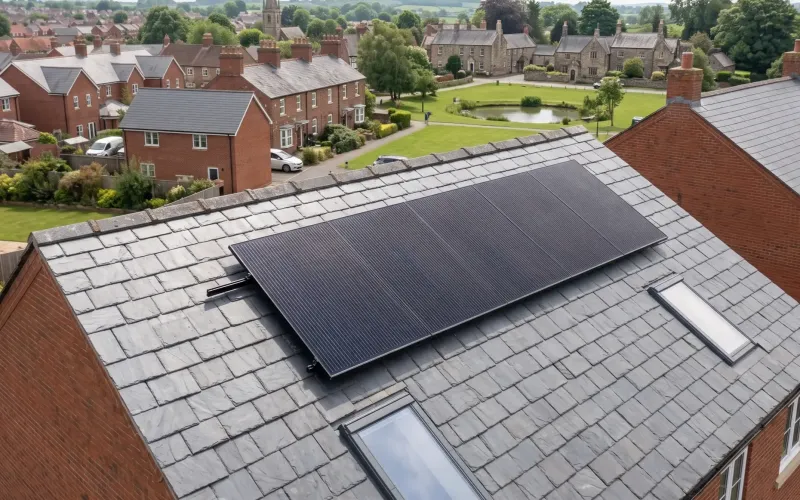
Solar panels change the appearance of your roof, which can be a concern for some homeowners. Planning restrictions may also apply in conservation areas or for listed buildings. Modern all-black panels are far less visually intrusive than older silver-framed models, but it's worth seeing a recent installation before deciding.
Which Households Benefit Most From Solar Panels?
The value of solar panels varies depending on how and when you use electricity. Here's where the returns are strongest.
Families with high daytime usage
More people at home during the day means more of your solar electricity is consumed directly rather than exported. Larger households with higher electricity bills see the biggest absolute savings.
Homeowners who work from home
Running a computer, lighting, and appliances during daylight hours aligns with peak solar generation. Self-consumption rates of 50–60% are realistic without a battery, which translates directly into higher savings.
EV owners
A solar-compatible charger can divert surplus solar electricity straight into your car. A 4kW system generates enough electricity annually to cover 10,000+ miles of EV driving.
Retirees and those home during the day
Higher daytime presence means more self-consumption and faster payback. Combined with the security of fixed energy generation costs, solar is particularly attractive for households on a fixed income looking to reduce ongoing bills.
Households planning further energy upgrades
Solar pairs with battery storage, heat pumps, and EV chargers to create a whole-home energy system. If you're planning to move away from gas over the next few years, solar is the foundation everything else connects to.
Who Should Think Twice?
Solar panels aren't the right choice for every home. It's worth pausing if:
You're planning to move within the next 2–3 years. You may not recoup the full investment, though panels will add value to the property when you sell.
Your roof is north-facing with significant shading. Output may be too low to justify the cost.
Your electricity usage is very low (under 2,000kWh per year). The savings may not cover the outlay within a reasonable timeframe.
Your roof needs replacing soon. Get the roof done first, then install panels on the new surface.
You're in a conservation area or listed building. Planning restrictions may limit or prevent installation. Check with your local authority before proceeding.
Solar Panels vs Doing Nothing
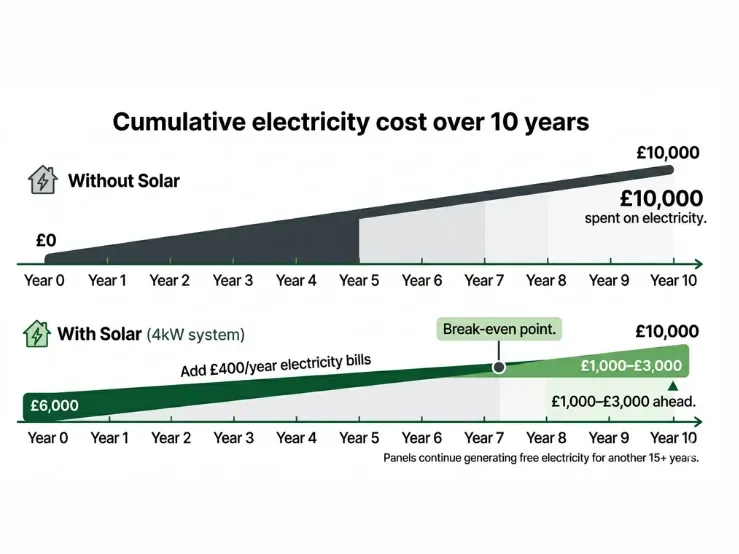
Here's what a typical 4kW solar system looks like financially over 10 years, compared to staying on grid electricity alone.
Cost / Saving Area | With Solar (4kW system) | Without Solar |
Upfront cost | ~£6,000 | £0 |
Annual electricity bill | ~£400 | ~£1,000 |
10-year electricity spend | ~£4,000 | ~£10,000 |
SEG income (10 years) | ~£500–£1,000 | £0 |
Net position after 10 years | £1,000–£3,000 ahead | £10,000 spent |
Based on a 3-bed home with a 4kW system at 50% self-consumption. Electricity unit rate of 24.5p/kWh. Annual bill estimate based on domestic consumption of 2,700kWh as used by Ofgem. Savings increase with battery storage or a time-of-use tariff.
After year 10, the gap widens further. Your panels continue generating free electricity for another 15+ years while grid prices continue to rise.
Are Solar Panels Worth It?
For most UK homeowners with a suitable roof and reasonable electricity usage, solar panels are worth the investment. A typical system pays for itself in 6–10 years, continues generating free electricity for 15–20 years beyond that, and increases your property value in the meantime.
With 0% VAT, potential ECO4 funding for eligible households, and electricity prices showing no sign of returning to pre-2021 levels, the financial case is stronger in 2026 than it has ever been.
The upfront cost is significant, not every roof is suitable, and output varies by season. But for the majority of homes, the pros of solar panels comfortably outweigh the drawbacks.
Get Started With Solar
Elite Energy have installed over 5,000 energy solutions across Teesside, County Durham, Tyne & Wear, Yorkshire, and the wider North East. MCS-certified, with more than 15 years in the energy industry, we handle everything from survey through to installation and aftercare.
Request a free solar quote or use our solar panel price calculator to get an estimate in 60 seconds.