Cost of Solar Panels in the UK (2026 Guide)

Elite Energy News

Cost of Solar Panels in the UK (2026 Guide)
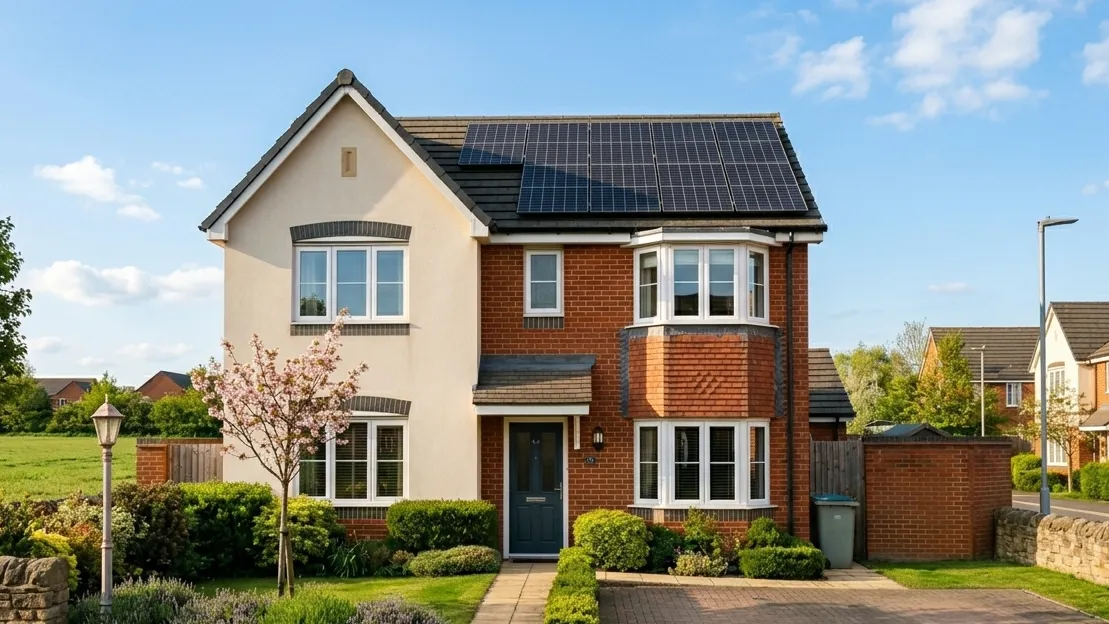
The cost of a solar panel installation in the UK ranges from under £4,000 for a smaller system to around £8,500 for a larger setup with battery storage. A typical 10-panel system with a 6 kW battery starts at £6,495.

Our guide covers everything that affects what you'll pay: solar installation costs by system size and property type, what's included in the price, how much you can save, estimated payback periods, available funding and incentives, panel efficiency, and ongoing maintenance costs.

How Much Do Solar Panels Cost in 2026?

Solar panel installation costs in the UK depend on system size, panel count, and whether battery storage is included.

A smaller system suited to a 1–2 bedroom property can start from under £4,000, while a larger system with battery storage for a 4–5 bedroom home typically sits between £7,500 and £8,500. Prices have come down considerably over recent years, and most homeowners will find a suitable system somewhere within that range.

The main factors that affect what you'll pay are the number of panels, the system capacity (measured in kW), the type of panels and inverter used, your roof layout, and whether you add battery storage.

Solar Panel Installation Costs

To give you a clear benchmark, here are fully installed prices based on Elite Energy's current packages. These include panels, inverter, all electrical and roofing work, bird protection, and bespoke system design.

Package

System size

Estimated cost

6-panel system

2.79kW

£3,995

6-panel system with battery

2.79kW

£5,995

10-panel system with battery

4.65kW

£6,495

16-panel system with battery

7.44kW

£7,495

20-panel system with battery

9.3kW

£8,495

Every property is different, so each system is designed around your roof size, energy usage, and generation goals. For a personalised estimate based on your property, try our solar panel price calculator.

Other Solar Costs to Consider

  • Battery Storage: For solar-only installations, a battery can be added from around £2,000. Adding a battery increases the proportion of solar energy you use in your home rather than exporting it, which directly improves savings and shortens your payback period.

  • Inverter: Typically included in every installation. The inverter converts the DC electricity your panels produce into AC electricity your home can use. Hybrid inverters are ideal for battery systems or future battery compatibility. Standard inverters suit solar-only installations but aren't compatible with battery storage without further additions. Inverters typically last around 10 years and cost £500–£1,000 to replace.

Can I Get Discount or Support on Solar Panels?

There are several ways to reduce the cost of a solar panel installation, from government-backed funding schemes to bank incentives and tax relief.

  • 1

    ECO4 and LA Flex: Fully Funded Solar Installations

    If you receive qualifying benefits, are on a low income, or live in a home with a low EPC rating, you may be eligible for a fully funded solar panel installation through the ECO4 scheme. This government-backed programme supports energy efficiency upgrades for eligible UK households at no cost to you. LA Flex extends eligibility to households that don't meet the standard benefits criteria but are still considered at risk of fuel poverty.

    We're an approved ECO4 installer and can check your eligibility as part of your consultation. If you qualify, we manage the full application from start to finish.

  • 2

    0% VAT on Solar Installations

    Solar panel installations currently benefit from 0% VAT in the UK. While this isn't a grant, it reduces the upfront cost compared to the standard 20% VAT rate, saving homeowners hundreds of pounds on a typical installation.

  • 3

    Bank Incentives for Energy-Efficient Home Improvements

    Several UK lenders now offer incentives for energy-efficient upgrades, which can help reduce the overall cost of installing solar:

    • Nationwide Building Society offers existing mortgage customers the option to borrow between £5,000 and £20,000 at 0% interest for a fixed period, when funds are used for upgrades such as solar panels

    • Halifax provides cashback for qualifying installations, including up to £1,000 when installing solar panels or battery systems

    • Barclays offers a Greener Home Reward, giving customers up to £2,000 back when completing eligible energy-efficiency improvements

    • Lloyds Bank provides similar incentives, including cashback for solar installations and a free Energy Performance Certificate following completion

  • 4

    Spread the Cost with Finance

    At Elite Energy, we offer solar panel finance through Klarna at 21.9% APR, allowing you to spread the cost of your installation over monthly payments. This means you can start generating savings while paying for the system over a term that suits your budget.

What Affects the Cost of Solar Panel Installation?

Several factors influence the final cost of a solar panel installation. Here's what affects the price and why.

  • Number of panels and system size: A larger system generates more electricity but requires more panels and a higher-capacity inverter. The right size depends on your electricity usage and how much of your bill you want to offset.

  • Panel type and efficiency: Higher-efficiency panels generate more electricity per square metre, which matters when roof space is limited. We use advanced 465W all-black panels selected for high efficiency, modern appearance, and strong long-term performance.

  • Roof type and layout: A single concrete tiled roof is the most straightforward to install on. Multiple roof sections, slate, flat roofs, or more complex layouts increase installation time and materials.

  • Roof orientation and pitch: South-facing roofs at around 30–35° produce the most electricity. East and west-facing roofs still generate well but may produce 10–15% less annually.

  • Scaffolding and access: Standard scaffolding is typically included in the price. Difficult access or multi-storey properties may add to costs.

  • Battery storage: Adding a battery increases the upfront cost but means you use more of your solar energy in the home rather than exporting it. This improves your savings and shortens your payback period.

  • Inverter type: Hybrid inverters cost more than standard inverters but allow for battery storage now or in the future. Standard inverters suit solar-only installations but aren't compatible with battery systems without further additions.

  • Electrical work: Some properties need a consumer unit upgrade or additional wiring to support the system. This is identified during the survey and included in the quote.

How Much Can I Save with Solar Panels?

How much you save depends on your system size, how much of the generated electricity you use in your home, whether you have battery storage, and which export tariff you're on.

System

Est. annual generation

Est. annual savings

2.79kW + battery

2,232–2,511kWh

£495–£560

4.65kW + battery

3,720–4,185kWh

£830–£930

7.44kW + battery

5,952–6,696kWh

£1,325–£1,490

9.3kW + battery

7,440–8,370kWh

£1,655–£1,860

Based on 465W all-black solar panels and typical North East generation of 800–900 kWh per kWp per year. Assumes 75% self-consumption / 25% exported. Import saving at 24.67p/kWh, export payment at 15p/kWh.

How Solar Savings Work

Your solar panels can save you money in 3 ways:

Reduced Electricity Bills

Every kWh you generate and use in your home is a kWh you don't buy from the grid. With a battery, you store excess daytime generation and use it in the evening rather than exporting it, which significantly increases the proportion you use yourself.

Smart Export Guarantee (SEG):

Any electricity you don't use is exported to the grid, and your energy supplier pays you for it. Export rates vary by provider – Octopus Energy's Intelligent Octopus Flux tariff offers rates up to 32.17p/kWh, while British Gas, EDF, and E.ON offer export rates up to 15p/kWh. Every system we install is Smart Export ready so you can choose the best option for your circumstances.

Battery Storage and Savings

Without a battery, a typical household uses around 50% of its solar generation directly and exports the rest. With a battery, self-consumption increases to around 75% or more. Since the import rate is higher than typical export rates, using more of your own electricity is always more valuable than exporting it.
What Is the Payback Period on Solar Panels?

The payback period is how long it takes for your savings to cover the cost of installation. Based on our current pricing and estimated savings:

System

Panels

Est. cost

Est. annual savings

Est. payback

2.79kW + battery

6 panels

£5,995

£495–£560

10.7–12.1 years

4.65kW + battery

10 panels

£6,495

£830–£930

7.0–7.8 years

7.44kW + battery

16 panels

£7,495

£1,325–£1,490

5.0–5.7 years

9.3kW + battery

20 panels

£8,495

£1,655–£1,860

4.6–5.1 years

Solar panels have a lifespan of 25+ years, so once the system has paid for itself, every year of savings beyond that is pure return. A 7.44 kW system paying for itself in around 5 years has 20+ years of savings ahead of it.

Your actual payback period will depend on several factors. Rising electricity prices shorten it, as each kWh you generate becomes more valuable. Your choice of export tariff also matters – an Octopus Flux rate of 32.17p/kWh will improve returns compared to a standard 15p rate.

Household usage patterns play a role too – the more electricity you use during daylight hours, the more you benefit directly rather than exporting. Roof orientation, shading, and seasonal variation will affect how much your system generates throughout the year.

How Efficient Are Solar Panels?

Solar panel efficiency refers to the percentage of sunlight that's converted into usable electricity. Most residential panels on the UK market operate at between 15–23% efficiency. The higher the efficiency, the more electricity each panel produces from the same amount of sunlight. Our panels operate at a maximum efficiency of 23%.

At Elite Energy, we use advanced 465W all-black panels, selected for their high efficiency, modern appearance, and strong long-term performance. These panels deliver better output in low-light conditions compared to older panel technologies.

Does Location Affect Output?

Yes. The average annual solar output in the North East is 800–900 kWh per kWp per year, compared to 900–1,100 kWh per kWp in the south of England. This means a system in the North East will generate less than the same system installed in London or the South West.

However, the economics still work. All of the savings and payback figures in this guide are based on North East generation data, not inflated national averages. A 7.44 kW system in the North East still pays for itself in around 5 years and generates savings for 20+ years beyond that.

Does Roof Direction Matter?

South-facing roofs at around 30–35° produce the most electricity. East or west-facing roofs still generate well but may produce 10–15% less annually. North-facing roofs are generally not suitable for solar. During your free survey, we assess your roof's orientation, pitch, and any shading to confirm expected output before you commit.

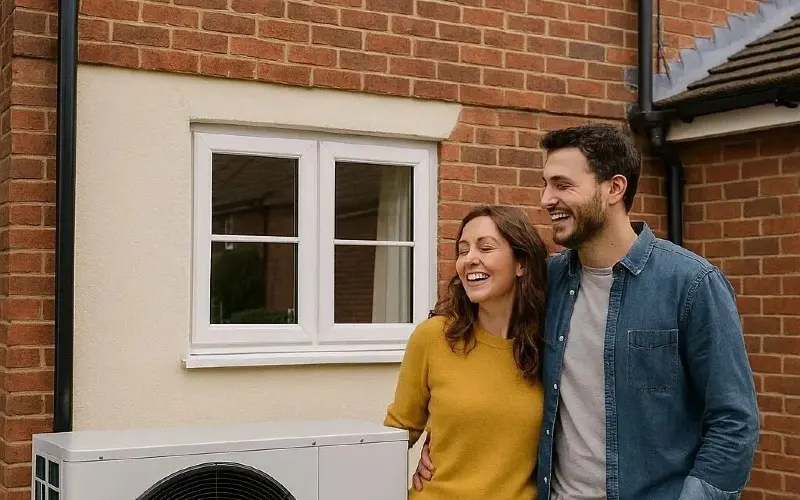
Pair Solar with an Air Source Heat Pump

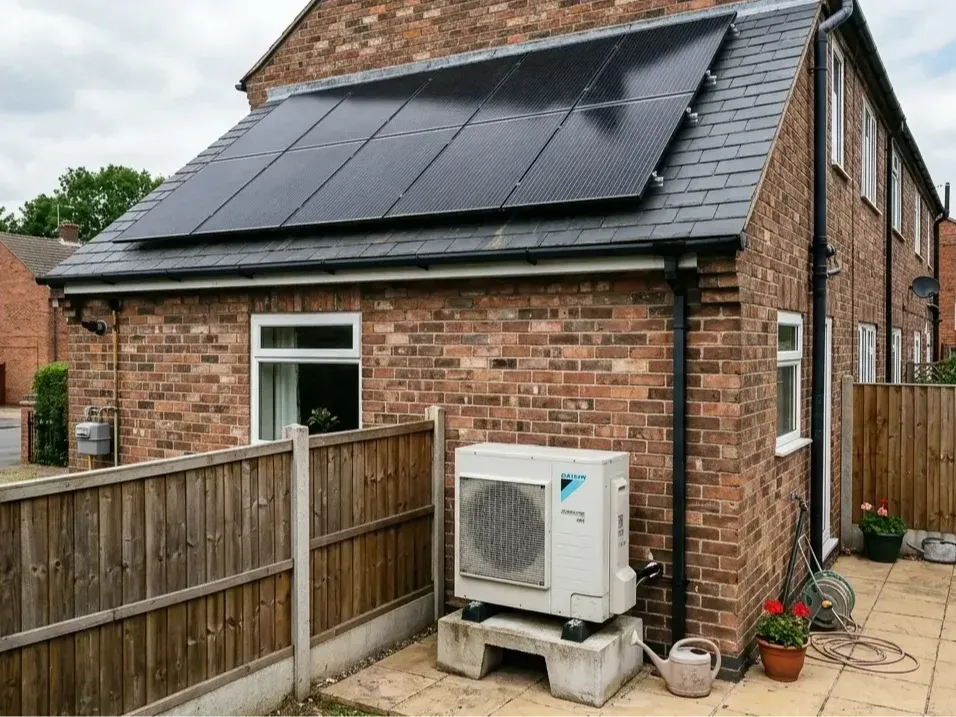
Homeowners who combine solar panels with an air source heat pump typically see their overall energy bills fall by over 60%.

Because a heat pump runs on electricity, generating your own through solar means a significant portion of your heating cost is covered by energy you've produced for free. During summer months, your solar system can produce enough electricity to heat your hot water entirely without drawing from the grid.

We're currently offering a free air source heat pump with any solar PV and battery installation.* We install both solar PV and air source heat pumps and can design them to work together from the outset.

Do Solar Panels Increase Property Value?

Research from Solar Energy UK, based on an analysis of over five million property transactions, found that solar panels can increase a home's value by 0.9–2%. On a property worth £200,000, that's an uplift of £1,800–£4,000 on top of the annual savings the system generates.

Solar panels also improve your home's EPC rating, which is becoming increasingly important as minimum EPC standards for rental properties tighten and buyers pay more attention to energy efficiency when choosing a home.

What Maintenance Do Solar Panels Need?

Solar panels require very little ongoing maintenance. They have no moving parts, and in most cases rainwater keeps them clean on a sloped roof.

An annual service is recommended to keep your system running efficiently and maintain manufacturer warranties. At Elite Energy, our annual solar service costs £195 + VAT and is carried out by the same in-house team that installed your system. This typically covers a visual inspection of the panels, a check on the inverter and electrical connections, and confirmation that the system is generating as expected.

The inverter is the one component that may need replacing during the lifespan of the system. Most inverters last around 10 years and cost £500–£1,000 to replace.

Solar panels themselves are typically warranted for 25 years and continue generating electricity beyond that, though output gradually decreases over time. Most manufacturers guarantee at least 80–85% of original performance after 25 years.

Get Your Solar Panel Quote

If you're in Teesside, County Durham, Tyne and Wear, Northumberland, or Yorkshire, our team can survey your property, confirm the right system size, and give you a fixed price.

Every system is designed around your property, with pricing confirmed after your free survey. If you qualify for ECO4 funding, we handle the full application.

Solar Panel Cost FAQs

How many solar panels do I need?

It depends on your electricity usage and available roof space. A typical 2-bed home uses around 2,000–2,700 kWh per year, which a 6-panel system can largely cover. A 3-bed semi uses around 3,000–4,000 kWh, where a 10-panel system is a better fit. For a more detailed breakdown, see our guide on how many solar panels can I fit on my roof.

Can I add a battery later?

Yes. If you start with a solar-only system, a battery can be added later from £1,995. If you're planning to add one in the future, we can install a hybrid inverter from the outset so the system is battery-ready.

Do solar panels work on cloudy days?

Yes. Solar panels generate electricity from daylight, not direct sunlight. Output is lower on overcast days, but panels still produce energy throughout the year. The generation figures in this guide already account for typical UK weather conditions.

How long do solar panels last?

Most panels are warranted for 25 years and continue generating beyond that. Manufacturers typically guarantee 80–85% of original performance after 25 years.

Do I need planning permission?

In most cases, no. Domestic rooftop solar installations fall under permitted development rights in England. Exceptions can apply for listed buildings, conservation areas, and installations that protrude significantly from the roof plane. We confirm this during the survey.

Is solar worth it in the North East?

Yes. Annual generation in the North East is 800–900 kWh per kWp, which is lower than the south of England, but the economics still work well. A 16-panel system with a battery has an estimated payback period of 5.0–5.7 years, with 20+ years of savings beyond that. All figures in this guide are based on North East data.

Can I get solar panels for free?

You may be able to through the ECO4 scheme. If your home has a low EPC rating and you receive qualifying benefits, the full cost of a solar installation could be covered. We check eligibility as part of your consultation.

What happens if I move house?

Solar panels stay with the property. They become a feature of the home and can increase its value by 0.9–2% according to research from Solar Energy UK. Any remaining warranty transfers to the new owner.

Get A Quote