
Elite Energy News
How Do Solar Panels Work?
How Do Solar Panels Work for Your Home?
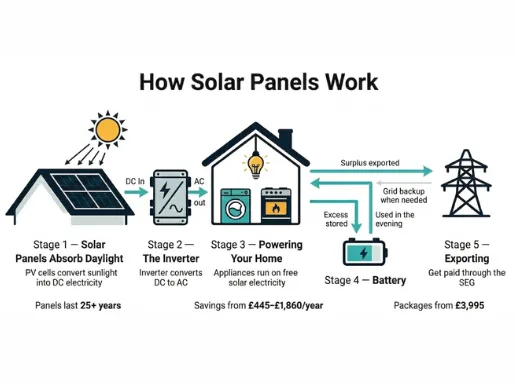
Here's how a solar panel system works across a typical day in your home.

Daytime
Your panels generate electricity whenever there's daylight. Any appliances running during this time are powered by solar first, reducing what you draw from the grid. This is called self-consumption, and it's where the biggest savings come from, because every kWh you use from your panels is a kWh you don't pay for at the current rate of around 24p.

Excess Generation
On brighter days, particularly when you're out or not running many appliances, your panels will produce more than your home needs. If you have a battery, this surplus charges automatically. If you don't, or the battery is full, the excess is exported to the grid and you're paid for it through the Smart Export Guarantee. Export rates vary by supplier, with some tariffs paying up to 32p per kWh.

Evening
Once daylight fades and your panels stop generating, your home switches to battery power if you have one. The energy stored during the day is discharged to power your home through the evening. A typical 6 kWh battery can store enough to cover most of an evening's usage.

Overnight
When your battery is depleted, or if you don't have one, your home draws from the grid as normal. You only pay for the grid electricity you actually use. Some homeowners on time-of-use tariffs also use cheaper overnight rates to top up their battery, ready for the next day's peak hours.
What Are Solar Panels Made Of?
A solar panel is made up of several layers, each with a specific role in protecting the cells and maximising electricity output.

The Cells
The core of every solar panel is the photovoltaic cell, made from silicon, a semiconductor material. When light hits the silicon, it causes electrons to move, creating an electrical current. A typical residential panel contains 60–72 of these cells wired together to produce a usable output.

The Layers
Each cell sits between a sheet of tempered glass on the front, which protects the cells while allowing light to pass through, and a polymer backing sheet on the rear. An anti-reflective coating is applied to the glass surface to help the cells absorb as much light as possible rather than reflecting it away.

The Frame
An aluminium frame surrounds the panel, providing structural support and allowing it to be securely mounted to your roof. The frame also protects the edges of the glass and backing from weather damage over the panel's 25+ year lifespan.


