
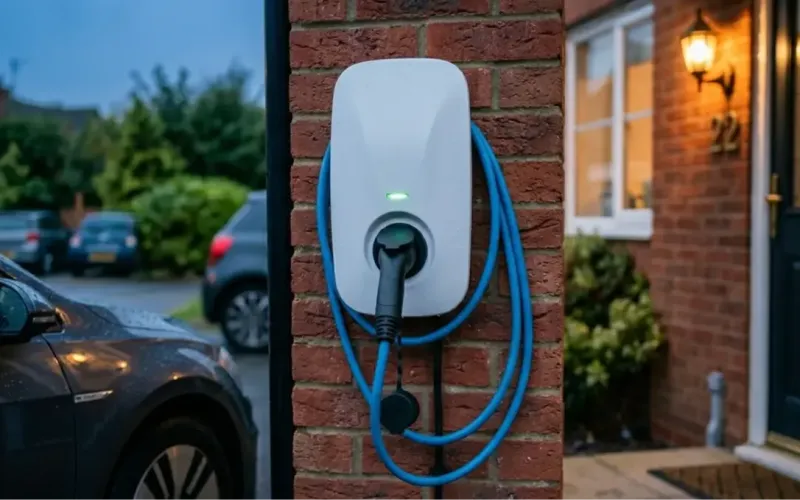
Home EV Charger Guide

Elite Energy News

Home EV Charger Guide

A home EV charger is one of the best investments any electric vehicle owner can make, charging at home costs 3–5x less than public chargers, pays for itself in as little as 4–6 months, and means you wake up to a full battery every morning without leaving the house.

Our home EV charger guide covers whether you need one, what it costs, how long charging takes, the savings vs public charging and petrol, how much electricity a charger actually uses, and how to choose the right one for your home.

At Elite Energy, we install smart EV chargers across Teesside, County Durham, Tyne & Wear, and Yorkshire. Request a free quote or explore everything you need to know below.

Quick Navigation:

Is a Home EV Charger Worth It?

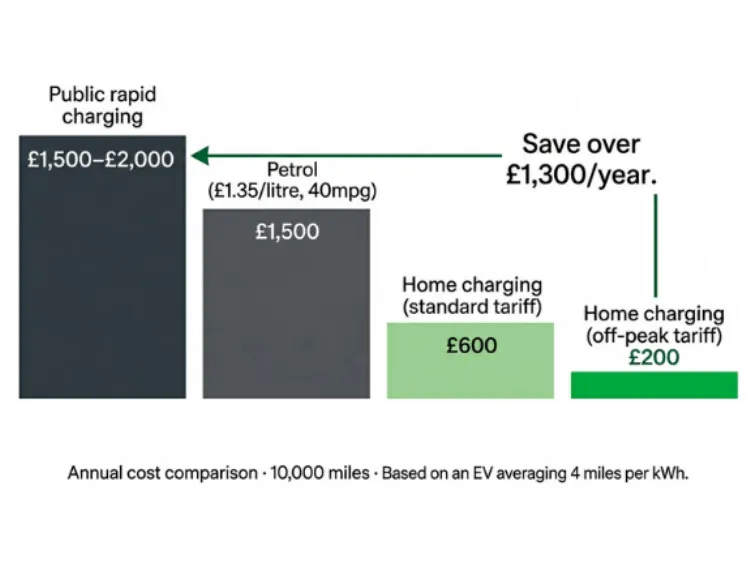
Yes, for any EV owner with off-street parking, a home charger is one of the smartest upgrades you can make. Public rapid chargers typically cost 50–80p per kWh, while home charging on an off-peak EV tariff costs as little as 7–8p per kWh. Over 10,000 miles of driving, that's the difference between spending £1,500–£2,000 a year on public charging and around £200 at home. Compared to petrol at roughly 15p per mile, home charging at 2–3p per mile cuts your fuel costs by around 80%.

There's also the convenience. You plug in when you get home and your car charges overnight, no detours to charging stations, no waiting in car parks, no worrying about whether a charger will be available or working. You start every morning with a full battery and only ever need public chargers on longer journeys.

For most regular EV drivers with a driveway, the numbers make a home charger the obvious choice. We cover exactly what it costs and how much you'll save in the sections below.

Who Should Get a Home EV Charger?

  • You have off-street parking – a driveway, garage, or dedicated space

  • You drive an EV or plug-in hybrid as your daily vehicle

  • You want to significantly cut your per-mile running costs

  • You're tired of planning around the public charging network

  • You have or plan to install solar panels – charge your car from free solar electricity

When Public Charging Might Be Enough

  • You don't have off-street parking and no realistic way to install one

  • Your daily mileage is very low (under 20 miles) and you have access to workplace charging

  • You only drive occasionally and can plan around public chargers

How Much Does a Home EV Charger Cost?

A home EV charger costs £800–£1,300 fully installed in the UK, including the charger unit, labour, cabling, and commissioning. At Elite Energy, fully installed packages start from £795 across three tiers:

Tier

Price From

What You Get

Core

£795

High-quality entry-level charger with standard installation

Premium

£995

Smart charger with app control, enhanced monitoring, and greater flexibility

Elite

£1,295

Top-of-the-range smart charger with premium design, full integration, and advanced features

All three packages include EV ultra cabling, bespoke consumer board and surge protection, and full installation and commissioning. You can view the full range on our EV charger products page.

What's Included in EV Charger Installation?

  • Charger unit: £300–£700 depending on brand and features. A smart 7kW charger with app control sits at the lower end; premium models with solar compatibility or design finishes cost more.

  • Installation labour: £300–£600 for a standard fit. This covers wall mounting, running a dedicated cable from your consumer unit to the charger location, fitting the required safety devices, testing, and handover.

  • DNO notification and certification: Your installer notifies your Distribution Network Operator and issues a Part P Building Regulations certificate - both included as standard.

What Can Increase EV Charger Cost?

  • Long cable runs – if your consumer unit is more than 10 metres from the charger location, additional cabling and labour add cost.

  • Consumer unit upgrades – older fuse boxes with wire fuses may need replacing with a modern unit (typically £300–£500 extra).

  • Groundwork or trenching – if the charger is across the driveway from the house, cables may need to run underground.

  • Earth rod installation – some properties require an additional earth rod to meet current wiring regulations.

OZEV EV Charger Grant

The OZEV grant covers up to £500 or 75% of the total installation cost, whichever is lower. It's currently available for renters in any property type and homeowners living in flats; homeowners with driveways have not been eligible since April 2024.

Elite Energy are OZEV-approved installers. If you qualify, we apply the grant as a direct discount on your invoice, no separate application to manage. That means a Core package could start from as little as £295 after the grant.
Is It Cheaper to Charge My Car at Home?

Home charging is roughly 3–5x cheaper than public rapid charging and 4–6x cheaper than petrol per mile. For a typical driver covering 10,000 miles per year, the difference is significant, switching from public chargers to home charging on an off-peak tariff saves over £1,300 a year.

Charging Method

Cost Per Mile

Annual Cost (10,000 miles)

Home charging (off-peak tariff, ~7p/kWh)

~2p/mile

~£200

Home charging (standard tariff, ~24.5p/kWh)

~6p/mile

~£600

Public rapid charging (~50–80p/kWh)

~15–20p/mile

~£1,500–£2,000

Petrol (£1.35/litre, 40mpg)

~15p/mile

~£1,500

Based on an EV averaging 4 miles per kWh.

To put that into perspective: charging a 60kWh battery from 20% to 80% on a public rapid charger at 65p/kWh costs around £23. The same charge at home on an off-peak tariff costs roughly £2.50. Do that twice a week and you're saving over £2,100 a year, more than enough to cover the charger, the installation, and your electricity bill increase combined.

Even on a standard electricity tariff without any off-peak benefit, home charging still saves around £900 a year compared to public rapid chargers and roughly the same against petrol.

How to Maximise Your Home Charging Savings

  • Switch to an EV-specific tariff. This is the single biggest saving most EV owners can make. Tariffs like Octopus Go and E.ON Drive Smart offer overnight rates of 7–8p/kWh between roughly 11:30pm and 5:30am. The off-peak rate also applies to your entire home, so running your washing machine or dishwasher overnight cuts those costs too.

  • Schedule your charging. Every smart charger lets you set a charging schedule through its app, tell it your off-peak hours and it handles the rest. Plug in when you get home, and the charger waits until the cheapest window to start. No need to set an alarm or remember to plug in at midnight.

  • Pair with solar panels. A solar-compatible charger like the Zappi can divert surplus solar electricity directly into your car during the day. If your car is parked at home while your panels are generating, you're driving on free energy. A typical 4kW solar system generates enough electricity annually to cover 10,000–12,000 miles of EV driving. See our solar panel installation service for more.

  • Add battery storage. If your car isn't home during the day to catch solar generation, battery storage lets you store that surplus and use it to charge your car in the evening instead. You can also store cheap overnight electricity for daytime use across your whole home. Our battery storage guide covers costs, benefits, and whether it's worth it.

How Long Does It Take to Charge a Car at Home?

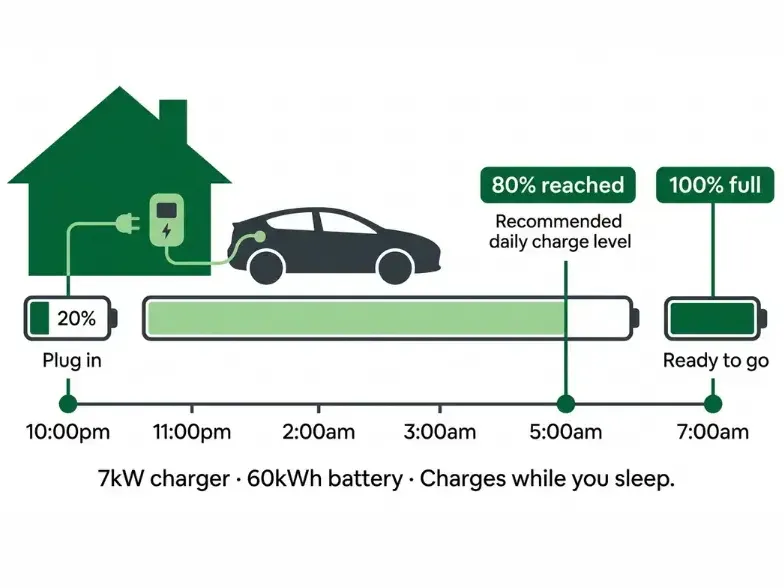
On a standard 7kW home charger, a full charge takes 6–10 hours depending on your car's battery size. In practice, most EV owners plug in when they get home and wake up to a full battery – charging fits around your routine, not the other way around.

You rarely charge from 0% either. Most daily top-ups take 2–4 hours, making overnight charging more than enough for the vast majority of drivers.

EV Model

Battery Size

7kW Full Charge Time

Range Added Per Hour

Nissan Leaf (40kWh)

40kWh

~6 hours

~28 miles

MG4 Standard

51kWh

~7.5 hours

~28 miles

VW ID.3 Pro

58kWh

~8.5 hours

~28 miles

Tesla Model 3 Standard

60kWh

~8.5 hours

~29 miles

Hyundai Kona Electric

65kWh

~9.5 hours

~27 miles

BMW iX1

65kWh

~9.5 hours

~27 miles

Times based on 0–100% on a 7kW charger. Daily top-ups from 50–80% take considerably less.

Why 7kW Is the Sweet Spot

Most UK homes run on a single-phase electricity supply, which supports up to 7kW of charging power. That's enough to add 25–30 miles of range per hour and fully charge any EV overnight.

By comparison, a standard 3-pin plug delivers just 2.3kW, around 8 miles of range per hour. It works in a pinch, but it's slow, puts sustained load on a socket not designed for it, and isn't recommended for regular use.

22kW chargers exist but require a three-phase supply, which most UK homes don't have. For the vast majority of domestic installations, 7kW is the right answer.

The 80% Charging Rule

Most EV manufacturers recommend charging to 80% for daily use and saving 100% for longer trips. The last 20% charges significantly slower as the battery management system protects cell health, so stopping at 80% is both faster and better for long-term battery longevity. On a typical 60kWh battery, reaching 80% on a 7kW charger takes roughly 7 hours.

How Much Electricity Does an EV Charger Use?

A 7kW home charger uses 7kWh of electricity for every hour it runs. A full charge on a typical 60kWh battery uses around 60kWh of electricity – but in practice, most drivers are topping up 20–40% each evening rather than charging from empty.

What that costs depends entirely on your tariff:

Charge Amount

kWh Used

Standard Tariff (~24.5p/kWh)

Off-Peak Tariff (~7p/kWh)

20% top-up

12kWh

£2.94

£0.84

40% top-up

24kWh

£5.88

£1.68

60% top-up

36kWh

£8.82

£2.52

80% top-up

48kWh

£11.76

£3.36

Full charge (100%)

60kWh

£14.70

£4.20

Based on a 60kWh battery. Most daily top-ups fall in the 20–40% range.

For a typical commuter doing 30–40 miles a day, that's a 20–30% top-up each evening, roughly 84p to £1.68 on an off-peak tariff. Over a full year of driving 10,000 miles, that adds around £175 to your electricity bill on an off-peak tariff or £615 on a standard rate.

Your electricity bill goes up, but your overall transport costs drop significantly. A driver spending £1,500 a year on petrol saves £885 on a standard electricity tariff or over £1,300 on an off-peak EV tariff.

The charger only draws power while the car is actively charging. Once the battery hits your target level, it stops automatically.

Tethered vs Untethered

There are two decisions to make before choosing a charger: tethered or untethered, and which feature set matters most to you.

Tethered chargers have the cable permanently attached, you unhook it from the unit and plug straight into your car. If you park in the same spot every day and want the fastest, simplest routine, tethered is the better choice. The trade-off is that the cable is always visible on the wall and the length is fixed, so check it reaches your charging port from where the unit will be mounted.

Untethered chargers use a separate Type 2 cable that you store and connect each time. They look cleaner when not in use, and if you change your car in future you simply swap the cable rather than replacing the unit. The extra step of connecting the cable each time is minor, but it's worth considering if convenience is your top priority.

What Is the Best EV Charger for Your Home?

We install three tiers of smart EV charger, each fully fitted with EV ultra cabling, bespoke consumer board and surge protection, and full commissioning. Here are our top picks from each range.

Core: SyncEV Wall Charger

UK-made 7.4kW smart charger with everything you need for efficient home charging, at the most competitive price in our range.

  • Wi-Fi and app control for scheduling, monitoring, and usage tracking

  • Dynamic load balancing to prevent overloading your home supply

  • No earth rod required (integrated PEN protection), making installation simpler and neater

  • 3-year warranty, IP55 weatherproof and IK10 impact rated

  • Best for reliable smart charging

  • From £795

Premium: Hypervolt Home 3

The all-rounder. Modern design, polished app, and reliable performance for homeowners who want smart charging without complexity.

  • Modern, compact unit that sits flush against the wall

  • Full app control for scheduling, monitoring, and cost tracking

  • Clear step up in build quality from entry-level chargers

  • Ideal upgrade for anyone replacing a basic or older charger

  • Best for everyday smart charging

  • From £995

Elite: Andersen

Top-of-the-range smart charger with the most advanced features, deepest integration capabilities, and premium build quality across our range.

  • Full solar compatibility – divert surplus solar electricity directly into your car

  • Advanced app control with detailed energy reporting and consumption data

  • Load management to prevent overloading your home supply

  • Over 200 colour finishes and concealed cable design as standard

  • Best for premium design

  • From £1,295

Get Started With a Home EV Charger

Home EV charger installations from Elite Energy start from £795 fully fitted. With over 5,000 completed installations, more than 15 years in the energy industry, and OZEV-approved engineers, we'll survey your property, recommend the right charger, and handle everything from cabling to commissioning. Covering Teesside, County Durham, Tyne & Wear, Yorkshire, and the wider North East.

Frequently Asked Questions

Can I install an EV charger myself?

No. UK regulations require EV chargers to be installed by a qualified electrician who can certify the work under Part P Building Regulations. The installation involves a dedicated high-load circuit, protective devices, and DNO notification – all of which must meet BS 7671 wiring standards. A DIY installation won't be covered by warranty, won't qualify for the OZEV grant, and could be a safety risk.

Do I need planning permission?

Most domestic EV charger installations fall under permitted development and don't require planning permission. If you live in a listed building or conservation area, there may be additional restrictions on where the unit can be mounted. Your installer will advise during the survey.

How long does installation take?

A standard home EV charger installation takes 2–4 hours. More complex jobs, long cable runs, consumer unit upgrades, or groundwork, may take up to a full day. Either way, it's a single-visit job with minimal disruption.

Will a home EV charger increase my property value?

Yes. With EV ownership growing rapidly in the UK, a home with a charger already installed is increasingly attractive to buyers. It signals lower running costs, a future-ready property, and one less expense for the new owner to arrange. The value added typically exceeds the cost of installation.

Do I need to tell my energy supplier?

You don't need permission, but it's worth switching to an EV-specific tariff before your charger is installed. Tariffs like Octopus Go offer overnight rates of 7–8p/kWh, without one, you're charging at the standard 24.5p/kWh rate and missing out on the biggest savings available.

Get A Quote