Solar Battery Storage: The Complete UK Guide for 2026

Elite Energy News

Solar Battery Storage: The Complete UK Guide for 2026
Solar battery storage allows you to store excess electricity from your solar panels during the day and use it in the evening, instead of exporting it to the grid at 4–5p/kWh and buying it back at 24.5p/kWh. With the right setup, you can also store cheap overnight electricity and use it during peak hours, even without solar panels. Systems typically cost between £2,500 and £7,500 depending on capacity.

Our guide covers how solar batteries work, what size you need, what they cost in 2026, the real benefits (including tariff arbitrage without solar), how installation works, and an honest look at whether storage is actually worth the investment.

At Elite Energy, battery storage installations start from £1,995. If you already know what you're after, you can request a free quote – otherwise, read on.

How Do Solar Batteries Work?

A solar battery stores surplus electricity that your solar panels produce during the day and releases it when your panels aren't generating – typically in the evening, overnight, or during cloudy weather. Instead of sending that excess energy back to the grid at a fraction of the import price, you keep it in the battery and use it later, replacing electricity you would otherwise have to buy at full cost.

The result is that more of the electricity your panels generate actually powers your home, which is the single biggest factor in how quickly a solar and battery system pays for itself.

The Charge and Discharge Cycle

The way a solar battery operates can be broken down into a simple daily cycle.

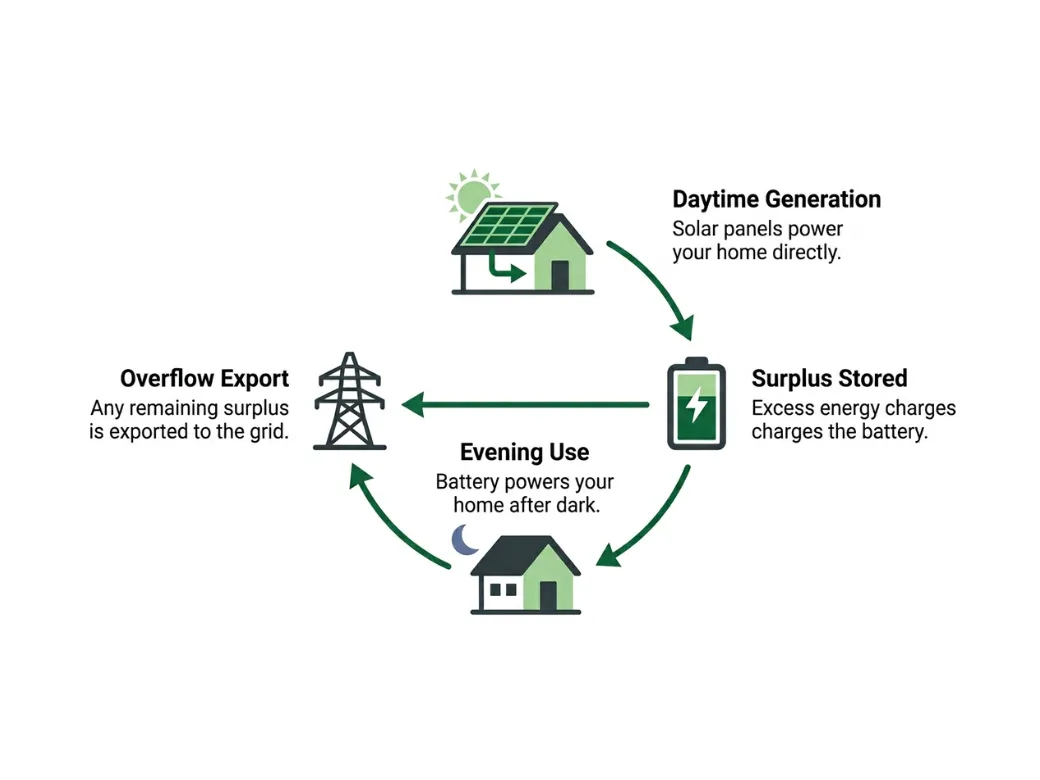
During the day, your solar panels generate electricity. Whatever energy your home needs is consumed directly from the panels. Any electricity your panels produce beyond what the house is using at that moment flows into the battery, charging it.

When the battery is full, any further surplus is exported to the grid. If you're registered for the Smart Export Guarantee (SEG), you'll receive a small payment for each kilowatt-hour you export, though this is typically much less than what you'd pay to buy that same electricity back.

In the evening and overnight, when the panels stop producing, the battery discharges to power your home, rather than being drawn from the grid at full price.

The cycle repeats the next day. Most home batteries complete one full charge and discharge cycle per day. The entire process is managed automatically by the inverter, which directs energy between the panels, battery, home, and grid without any input from you.

What's Inside a Solar Battery System?

A home battery system is made up of three main components.

  • The battery unit itself stores the electricity; virtually all residential batteries use lithium iron phosphate (LFP) cells, which offer the best combination of safety, lifespan, and cost.

  • The inverter manages the flow of electricity between the panels, battery, home, and grid, converting between direct current (DC) and alternating current (AC) as needed.

  • The monitoring system, usually a smartphone app, gives you real-time visibility of how much energy you're generating, storing, using, and exporting.

AC-Coupled vs DC-Coupled Battery Systems

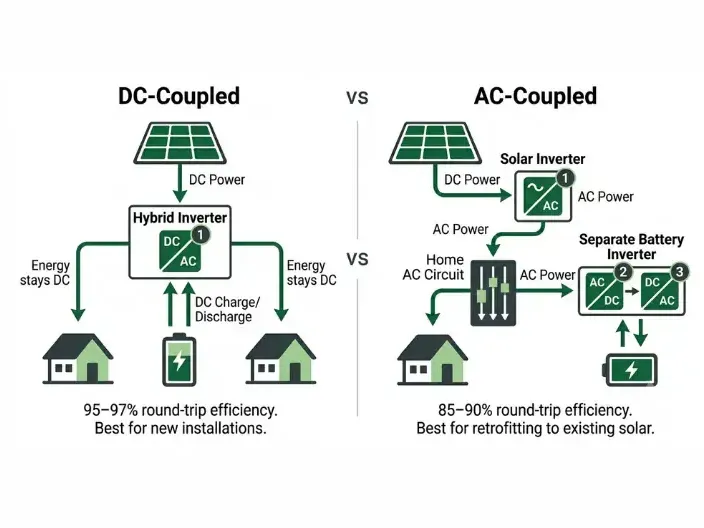
There are two terms that describe how the battery connects to your system: AC-coupled and DC-coupled. The right option for your home depends mainly on whether you're adding a battery to an existing solar setup or installing everything together as a new system.

DC-Coupled (Best for New Installations)

In a DC-coupled system, the solar panels and battery share a single hybrid inverter. Solar energy flows directly into the battery as DC electricity before being converted to AC once, when it's needed to power your home. This means fewer conversion steps and higher efficiency, typically 95–97% round-trip, meaning you keep almost all of the energy you store.

DC-coupled systems are the best choice when you're installing solar panels and a battery together from scratch, or when your existing inverter is due for replacement.

AC-Coupled (Best for Retrofit)

In an AC-coupled system, the battery has its own separate inverter and connects to your home's AC circuit independently. Energy goes through extra conversion steps – DC from the panels to AC, then AC back to DC for storage, then DC to AC again when discharged – which means slightly lower efficiency (85–90% round-trip).

The advantage is flexibility. An AC-coupled battery can be added to any existing solar panel system without replacing the current inverter, which makes it the best choice when you're retrofitting storage onto a system that's already up and running.

Your installer will recommend the right option during the survey stage. At Elite Energy, we assess your existing setup and energy goals before recommending a system, so you don't need to make this decision on your own.

Can You Use a Battery Without Solar Panels?

Yes. A home battery doesn't require solar panels to deliver savings. If you're on a time-of-use electricity tariff, a battery can charge overnight when electricity is at its cheapest and discharge during the day when rates are at their highest – a strategy known as tariff arbitrage. It's an option that's growing in popularity with homeowners who want to cut their energy costs without committing to a full solar installation.

How Battery Arbitrage Works

The savings come from the price difference between off-peak and peak electricity. Under the Ofgem Q2 2026 price cap, standard electricity costs around 24.5p per kilowatt-hour. Smart time-of-use tariffs like Octopus Go charge as little as 7–8p/kWh during off-peak hours, typically overnight.

A 10kWh battery charged overnight at 7.5p/kWh costs around 75p to fill. Using that same 10kWh during the day at standard rates would cost £2.45. That's a daily saving of roughly £1.70, adding up to over £600 a year, purely from shifting when you use electricity.

Smart battery systems handle this automatically. You set your tariff schedule once, and the system charges and discharges at the optimal times without any manual input.

Why Consider a Grid-Only Battery?

There are several reasons a battery without solar can make sense for the right household. You can cut electricity bills by storing cheaper energy and using it during expensive peak periods. You're protected against rising energy prices, because as the gap between off-peak and peak rates widens, your savings grow. And you reduce your reliance on the National Grid.

It's also an ideal starting point for homeowners who want energy savings now but may want to add solar panels later. A battery installed today works straight into a solar system added in the future, so you're future-proofing from day one.

If you're interested in a battery-only installation, our home battery storage service covers standalone setups as well as solar-paired systems.

How Do You Use a Solar Battery?

Once a solar battery is installed, it runs almost entirely on its own. The system charges and discharges automatically based on your solar generation, household consumption, and tariff schedule. There's very little you need to do day to day.

App Monitoring and Smart Control

Battery systems come with a smartphone app that shows your energy flow in real time. You can see how much your panels are generating at any given moment, how much is stored in the battery, what your home is drawing, and whether anything is being exported to the grid.

Daily, weekly, and monthly savings are tracked automatically, so you can see exactly how much the battery is saving you without having to calculate anything yourself. Many homeowners find that visibility changes their habits – once you can see when energy is cheapest and when your solar generation peaks, it becomes natural to run the washing machine or dishwasher at the optimal time.

For households on a time-of-use tariff, the system can be programmed to charge from the grid overnight at the cheapest rate and discharge during peak hours. Some systems also allow you to set preferences, for example, prioritising self-consumption of solar energy during the day, or maximising export earnings during high-value windows. These schedules can be adjusted through the app at any time.

Does a Battery Need Maintenance?

No. Home battery systems are maintenance-free. There are no moving parts, no fluids to top up, and no regular servicing required. The system monitors its own health, and your installer can often access diagnostics remotely if an issue arises. All you need to do is keep the area around the battery unit clear and well ventilated.

What Size Solar Battery Do I Need?

The right battery size depends on your household's energy consumption, when you use the most electricity, and whether you have or are planning to install solar panels. Most UK homes are well served by a battery between 5kWh and 13.5kWh, but the best size for your property will depend on your specific usage patterns.

How to Think About Sizing

A useful rule of thumb is to size your battery to roughly match your evening and overnight electricity consumption. If you know your daily electricity usage from your smart meter or energy bill, aim for a battery that covers around 50–70% of it. This captures the bulk of your savings without oversizing.

Homes with an electric vehicle or an air source heat pump should consider the larger end of the range. A heat pump running through a winter evening can draw 3–5kWh on its own, and an EV adds another 7–15kWh per overnight charge. A 5kWh battery would be drained quickly under those loads, whereas a 10–13.5kWh system has the headroom to handle them comfortably.

It's worth noting that bigger isn't always better. A battery that's significantly oversized for your usage pattern won't cycle fully each day, which extends the payback period without delivering proportional savings.

Not Sure? Start With a Survey.
The right size depends on your specific property, usage profile, and energy goals. A home survey gives you a recommendation based on real data rather than rough estimates. You can request a free quote and we'll assess your home to recommend the right system for your needs.

Solar Battery Sizing by Household Type

Battery Size

Best Suited For

Typical Daily Coverage

5kWh

1–2 bed homes, couples, low-to-moderate usage

Covers a typical evening's electricity – lights, TV, cooking, kettle

10kWh

3–4 bed homes, families, moderate-to-high usage

Covers the full evening peak and into the early morning

13.5kWh+

Larger homes, EV owners, heat pump households

Handles higher demand from concentrated loads like heat pumps and EV charging

How Much Does Solar Battery Storage Cost?

Costs range from around £2,500 for a smaller 5kWh system to £7,500 or more for a larger 13.5kWh unit. At Elite Energy, battery storage installation starts from £1,995, including the battery unit, installation, and commissioning.

Solar Battery Cost by Capacity

Battery Capacity

Typical UK Installed Cost

Elite Energy From

5kWh

£2,500–£3,500

From £1,995

10kWh

£4,000–£6,000

Quote-based

13.5kWh

£5,500–£7,500

Quote-based

It's also worth noting that battery storage installed alongside or after solar panels currently qualifies for 0% VAT in the UK (until March 2027), which can save you several hundred pounds on the total cost.

What Affects the Cost?

Several factors influence the final price of a battery storage installation.

Capacity is the biggest variable. More storage costs more, but larger batteries tend to cost less per kWh of capacity - so the price doesn't scale linearly.

Battery chemistry and brand play a role. LFP (lithium iron phosphate) batteries are the 2026 standard across the UK market, offering the best balance of safety, longevity, and price. They've largely replaced older NMC (nickel manganese cobalt) cells in residential installations.

AC-coupled vs DC-coupled affects cost. If you're adding a battery to an existing solar system (AC-coupled), the need for a separate battery inverter can add £500–£1,000 compared with including a battery as part of a new solar installation (DC-coupled with a hybrid inverter).

Installation complexity can also affect the price. Factors like the location of the battery unit, accessibility, and whether any electrical upgrades are needed all influence the labour involved.

What Are the Benefits of Solar Battery Storage?

The core solar battery benefits come down to one thing: keeping more of the energy you generate or buy cheaply, and using it when it's most valuable.
Maximise Your Solar Self-Consumption

Without a battery, a typical solar home uses just 40–50% of the electricity its panels generate, the rest is exported at rates as low as 4–5p/kWh. With storage, self-consumption rises to 70–80% or more. Every kWh you store and use yourself is worth roughly double what you'd earn by exporting it.

Cut Your Electricity Bills

On a time-of-use tariff, you store cheap overnight electricity and use it during expensive peak periods. With solar, you avoid buying grid electricity in the evening by using what your battery stored during the day. As energy prices rise, these savings grow proportionally.

Reduce Reliance on the Grid

A battery gives you a buffer against grid price fluctuations and supply uncertainty. Many modern systems can also provide backup power during short outages, keeping essential appliances running, though not all systems support this by default, so it's worth discussing with your installer.

Increase Your Property Value

Battery storage can contribute to a higher EPC rating and make your home more attractive to buyers focused on running costs. Industry estimates suggest a 10kWh system can add £1,500–£3,000 to a property's sale price.

Future-Proof Your Home

Smart grid integration, vehicle-to-grid (V2G) technology, and virtual power plants are all emerging developments that reward homes with storage. Having a battery in place now positions you to benefit from these opportunities rather than needing to retrofit later.

How Is Solar Battery Storage Installed?

A qualified, MCS-certified installer handles the full process, and most domestic installations are completed within a single day.

  • 1

    What the Process Looks Like

    • Survey: An installer visits your property to assess your energy usage, existing solar setup (if applicable), electrical system, and the best location for the battery unit. This is where the right battery size and system type (AC or DC-coupled) are recommended based on your property.

    • System Design: Based on the survey findings, a system is designed around your home. This includes the battery capacity, the coupling type, placement, and how the system will integrate with your existing setup or a new solar installation.

    • Installation: The battery unit is mounted in a suitable location, connected to your solar system and/or the grid, and fully commissioned. The monitoring app is set up and configured to your tariff schedule.

    • Handover: Your installer walks you through the system and the app, and you'll receive all relevant paperwork including your electrical installation certificate and DNO notification.

  • 2

    Where Can a Battery Be Installed?

    Under current UK fire safety guidance (PAS 63100:2024), batteries should be installed in well-ventilated, fire-safe areas – garages, utility rooms, and purpose-built external enclosures are most common. Lofts, bedrooms, stairwells, and small cupboards are no longer recommended for new installations.

  • 3

    Do I Need Planning Permission?

    Most domestic installations fall under permitted development. Your installer handles DNO notification and any additional considerations for listed buildings or conservation areas.

How Long Do Solar Batteries Last?

Modern home solar batteries typically last 10–15 years, with most manufacturers offering warranties covering 10 years or 6,000–10,000 charge cycles.

What Determines Battery Lifespan?

  • Cycle Count: A cycle is one full charge and discharge. Most home batteries complete one cycle per day, meaning a 10-year warranty covers around 3,650 cycles, well within the 6,000–10,000 cycle rating of quality LFP systems.

  • Depth of Discharge: This is how much of the battery's capacity is used each cycle. Modern LFP batteries can safely discharge to 90–100% without significant degradation, unlike older chemistries that needed to hold a larger reserve.

  • Battery Chemistry: LFP (lithium iron phosphate) is the UK residential standard in 2026,  it degrades more slowly than NMC alternatives, is more thermally stable, and prices have dropped significantly over the past three years.

What Happens After the Warranty Period?

Batteries don't stop working when the warranty ends. They gradually lose capacity over time, but most quality systems retain 70% or more of their original capacity after 10 years. So, a battery that started at 10kWh might deliver around 7kWh of usable storage after a decade. That's still enough to cover most of an evening's electricity usage for a typical household.

At that point, you can continue using the battery at its reduced capacity or replace it. Replacement costs are likely to be considerably lower by then, given the trajectory of battery prices over the past decade.
Is Battery Storage Worth It?

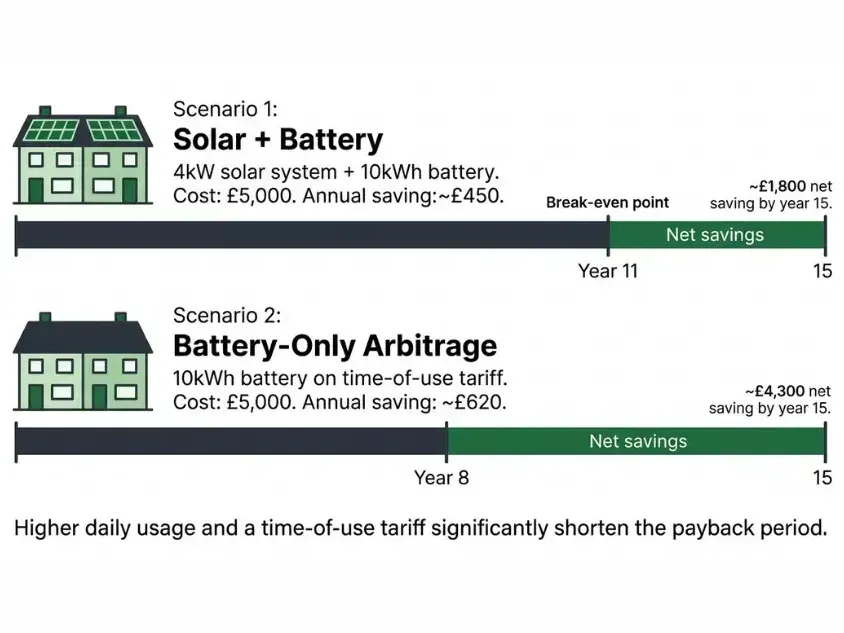
For most UK homeowners with solar panels or a time-of-use tariff, solar battery storage is a worthwhile investment in 2026. Typical payback falls between 7 and 12 years, and with warranties covering 10–15 years, that means several years of net savings beyond break-even.

As a worked example, a 10kWh battery costing £5,000 that saves £450 per year pays back in approximately 11 years. Payback improves further if you're on a time-of-use tariff, or if you have an electric vehicle or air source heat pump, both create concentrated demand that a battery can serve at off-peak rates.

When a Battery IS Worth It

A battery tends to make strong financial sense when several of the following apply to your situation:

  • Your solar self-consumption is currently below 50%.

  • You're on, or willing to switch to, a smart time-of-use tariff.

  • You have an EV or heat pump creating concentrated energy demand.

  • You plan to stay in your home for at least 8 years.

  • You value backup power during short grid outages.

  • You want to reduce your carbon footprint and long-term dependence on grid electricity.

When a Battery Might NOT Be Worth It (Yet)

There are situations where battery storage doesn't make financial sense right now, and it's important to be upfront about them:

  • You already use most of your solar generation during the day (e.g., you work from home).

  • Your annual electricity usage is very low (below 2,000kWh/year).

  • You're on a flat-rate tariff and don't plan to switch.

  • You'd benefit more from additional solar panels first – you can always add storage later.

If you're unsure, a property-specific assessment is the best way to get a clear answer. Get a free quote and we'll help you work out whether it makes sense for your home.

Get Started With Solar Battery Storage

Battery storage installations from Elite Energy start from £1,995. With over 5,000 completed installations, an MCS-certified team, and coverage across Teesside, County Durham, Tyne & Wear, and Yorkshire – we'll survey your property, recommend the right system, and handle everything from start to finish.

Frequently Asked Questions

How much does solar battery storage cost?

Between £2,500 and £7,500 depending on capacity. At Elite Energy, installations start from £1,995 including the battery unit, installation, and commissioning.

Is solar battery storage worth it?

For most homeowners with solar or a time-of-use tariff, yes – typical payback is 7–12 years with warranties covering 10–15 years.

Can I have a battery without solar panels?

Yes. A home battery can charge from cheap overnight grid electricity and discharge during expensive peak hours, saving you money through tariff arbitrage, no solar panels required.

Do solar batteries work in winter?

Yes. Solar generation is lower in winter, so the battery will store less energy from your panels during shorter days. However, on a time-of-use tariff, it can still charge from cheap overnight grid electricity regardless of the season, meaning it continues to deliver savings year-round.

Is there a government grant for solar battery storage?

Battery storage installed alongside or after solar panels currently qualifies for 0% VAT in the UK (until March 2027). Under the ECO4 scheme, some eligible households may also qualify for funded solar and battery installations. You can check what government energy grants may be available for your home.

Get A Quote