
Elite Energy News
How Air Source Heat Pumps Work

Step 1 – Evaporation
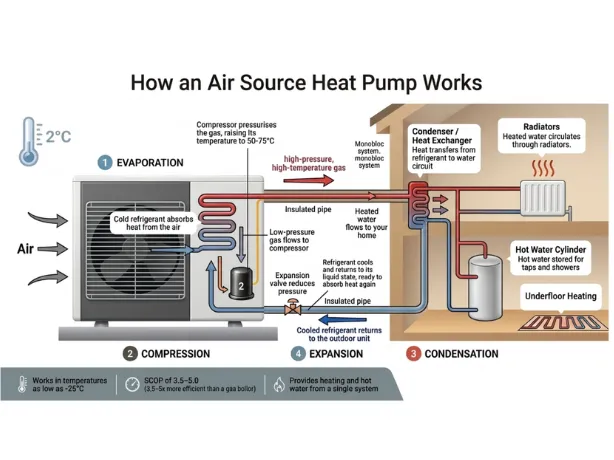
The outdoor unit contains a heat exchanger filled with refrigerant, a fluid with a very low boiling point (typically around -25°C to -30°C). A fan draws outside air across the heat exchanger. Even when the air temperature is low, it contains enough thermal energy to warm the refrigerant above its boiling point, causing it to evaporate from a cold liquid into a low-pressure gas.

Step 2 – Compression
The low-pressure gas is drawn into the compressor, the component that uses the system's electricity. The compressor squeezes the gas, increasing its pressure. When gas is compressed, its temperature rises. This is the same principle that makes a bicycle pump feel warm when you use it. The compressor raises the refrigerant temperature to between 50°C and 75°C, hot enough to heat your home and hot water.

Step 3 – Condensation
The hot, high-pressure gas passes through a second heat exchanger called the condenser. Here, the heat from the refrigerant transfers into the water in your central heating circuit. As the refrigerant releases its heat, it cools and condenses back into a liquid. The heated water is then circulated to your radiators, underfloor heating, or hot water cylinder.

Step 4 – Expansion
The liquid refrigerant passes through the expansion valve, which rapidly reduces its pressure. This drops the temperature back down, returning the refrigerant to its cold, low-pressure state, ready to absorb heat from the outside air again. The cycle then repeats continuously for as long as your home needs heating.
Is an Air Source Heat Pump Right for Your Home?
Air source heat pumps are suitable for a wide range of UK property types, from terraced houses to detached rural homes. Whether one is right for your property depends on a few factors.
If you're unsure, a free home survey can confirm whether an ASHP is suitable for your property, with no obligation to proceed.

Outdoor Space
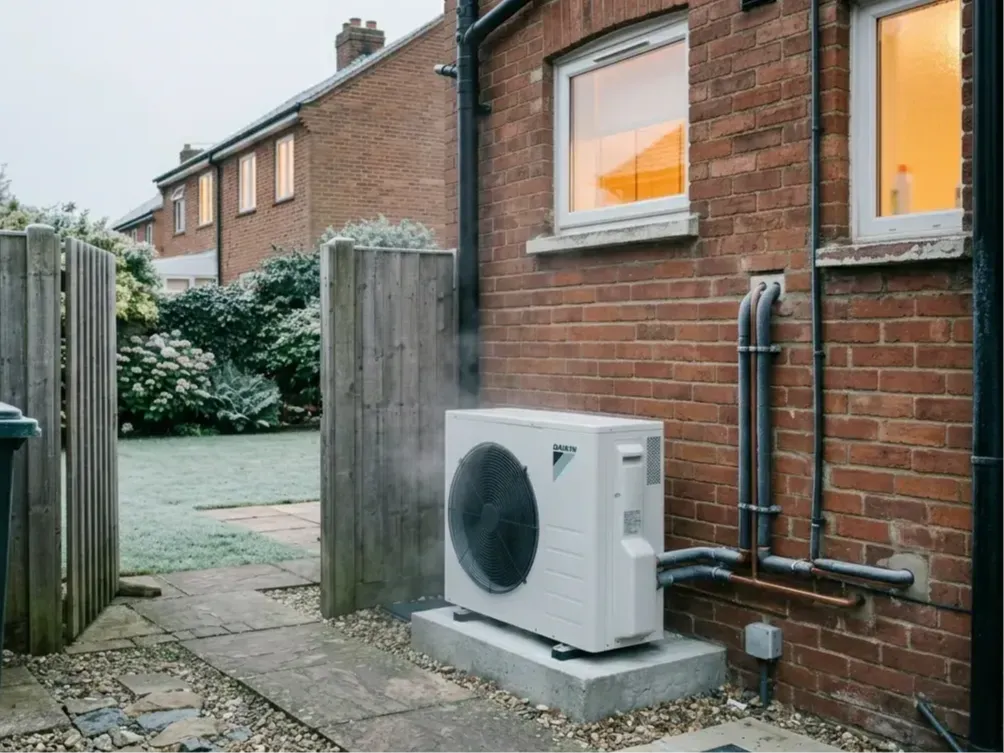
You need room for the outdoor unit with adequate airflow around it. A rear garden, side passage, or yard is usually sufficient.

Insulation
A well-insulated home gets the most from a heat pump. If your home loses heat quickly, the system has to work harder, which reduces efficiency. Where insulation improvements are needed, these can sometimes be included through ECO4.

Existing Heating System
Heat pumps can replace gas, oil, or LPG boilers. If your home currently uses a combi boiler, a hot water cylinder will need to be added. Existing radiators may work at lower flow temperatures or may need upsizing.

Electrical Capacity
A heat pump requires a dedicated electrical supply. Some older properties may need a consumer unit upgrade, which is identified during the survey.

Noise and Positioning
While modern units operate at around 40–50 decibels (similar to a fridge), positioning matters. The outdoor unit needs to be placed where airflow is unobstructed and where noise won't be an issue for you or your neighbours.


